

Why Existing Home Sales Keep Falling Despite Strong Job Numbers
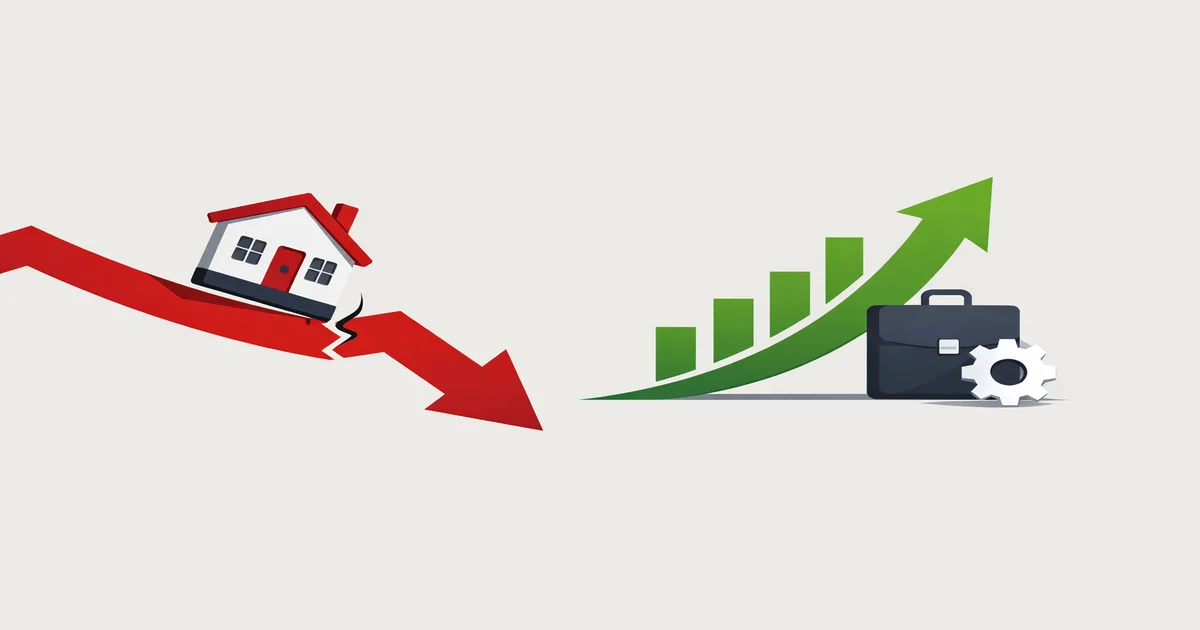
Nonfarm payrolls rose by 178,000 in March 2026 and unemployment edged down to 4.3%. Yet existing home sales fell 3.6% month-over-month to an annualized rate of 3.98 million — the lowest reading in nine months and well below the 4.06 million units analysts expected. The disconnect is not a fluke; it is the product of at least four compounding structural forces that job growth alone cannot fix.
TL;DR
- Existing home sales hit 3.98 million annualized in March 2026, the lowest in nine months, even as unemployment sat at 4.3%.
- When roughly 80% of outstanding mortgages carry rates at or below 6%, sellers refuse to list and trade into a 6.37% loan.
- Check your debt-to-income ratio and compare your last three mortgage statements before deciding whether to buy or wait.
Why Does a Strong Job Market Not Automatically Lift Home Sales?
Employment is a necessary condition for housing demand, but it is nowhere near sufficient. As NAR Chief Economist Lawrence Yun noted, there are more than 6 million more jobs than in 2019, yet home sales per year are down by one million. The math is blunt: jobs create buyers in theory, but only if those buyers can find a home they can afford and a seller willing to transact.
Consumers are dealing with a host of issues, including policy uncertainty, home prices, job security, and rising home maintenance and insurance costs, according to Zonda Chief Economist Ali Wolf. Job security is the operative phrase there. The U.S. labor market in early 2026 is shaped by rapid AI adoption and heightened geopolitical tensions, and while headline numbers show continued job growth and a stable unemployment rate, the underlying dynamics reveal a more complex picture.
That 178,000 payroll gain masks a meaningful shift: white-collar roles in finance, tech, and professional services are absorbing the sharpest AI-driven displacement, which means the workers most likely to qualify for a $400,000 mortgage are also the most anxious about their next performance review. Many house hunters remain priced out and limited by a stalled labor market, including some Americans who have lost their job — or fear losing their job — as AI takes a toll on the white-collar workforce. Fear of job loss suppresses big-ticket purchases even when the headline unemployment rate looks benign. That psychological drag does not show up in payroll data.
What Is the Mortgage Rate Lock-In Effect and Why Does It Still Matter?
Millions of homeowners who locked in mortgage rates below 3% during the pandemic-era boom have been reluctant to sell, knowing that any move would likely mean trading a historically low monthly payment for a far more expensive one — a dynamic that is one of the biggest forces constraining housing supply.
According to Realtor.com Chief Economist Danielle Hale, the market has reached a lock-in milestone where the share of mortgages greater than 6% now exceeds the share below 3% — but the lock-in remains a market headwind, as roughly 80% of mortgages still carry a rate of 6% or lower. That is a massive pool of sellers who have a strong financial incentive to stay put.
Mortgage rates were hovering near 6.4% for the 30-year fixed as of March 2026, about 40 basis points above late-February levels. For a median-priced home in the low $400,000s, that adds roughly $90 to the typical monthly payment, reversing part of last year’s affordability gains. A $90 monthly increase on a $400,000 home does not sound catastrophic, but compounded over a 30-year term it represents more than $32,000 in additional interest. Sellers with 3% mortgages are doing that math, and most are choosing not to list.
The bigger question is whether inventory can build fast enough to offset this freeze — which is what the next section addresses directly.
Is There Enough Housing Inventory to Support a Recovery?
Short answer: not yet. Unsold inventory totaled 1.36 million units in March 2026, equivalent to 4.1 months of supply. NAR estimates an additional 300,000 to 500,000 homes would be required to bring the market closer to balance.
Inventory levels remain well below historical averages on both an absolute level and a sales-ratio basis. A balanced market typically sits at five to six months of supply. Existing home inventory rose from a cyclical low of 2.3-months’ supply in 2021 to a 4.1-months’ rate in 2025, and Realtor.com projects it will reach a 4.6-months’ pace in 2026 — in line with a balanced market range of between four and six months. Progress, yes. Sufficient for a meaningful sales rebound, not quite.
Active listings rose 8.1% year-over-year according to ResiClub Analytics, but remain 13.6% below March 2019 levels. And 2019 was already an undersupplied market. With a nationwide shortage of roughly 1.2 million housing units, NAHB Chief Economist Robert Dietz argues the best way to ease the housing affordability crisis is for policymakers to remove barriers hindering builders from constructing more homes and apartments.
The regional picture is uneven. Eleven states including Florida, Texas, Arizona, Colorado, and Tennessee have surpassed pre-pandemic inventory levels, contributing to price softness in those markets. Florida has recorded a statewide home value decline of 4.3% year-over-year, while Austin, Texas, remains nearly 28% below its 2022 peak. Meanwhile, Midwest and Northeast markets where inventory remains constrained continue recording modest appreciation.
How Do Mortgage Rates Interact With Home Prices to Squeeze Buyers?
The median existing-home price reached $408,800 in March 2026 — up 1.4% from one year ago — marking the 33rd consecutive month of year-over-year price increases. Prices keep rising even as transaction volume falls, because limited supply props up valuations regardless of demand softness. That is the paradox that confuses most first-time buyers.
While price appreciation slowed significantly in 2025, average prices are still up about 30% since early 2020, putting homes out of reach for many buyers, according to Morgan Stanley strategists. Wage growth has been real, but it has not kept pace with that cumulative appreciation. Even with progress in affordability, middle-income buyers can afford to buy just 21% of the homes currently available for sale. Before the pandemic, they could afford about 50%.
As of May 7, 2026, the 30-year fixed-rate mortgage averaged 6.37%, up from 6.30% the prior week. A year ago at this time, the 30-year rate averaged 6.76%. The year-over-year improvement is real, but mortgage rates jumped from 3% in 2021 to above 7% in 2023, pushing the typical monthly payment up by more than $1,000 compared to pre-pandemic levels. Shaving 40 basis points off a rate that is still double the pandemic-era low does not meaningfully restore affordability for buyers who were priced out in 2022.
The affordability math only works if you run it against your actual income, not the advertised rate. Lenders verify debt-to-income ratios (DTI) — typically requiring 43% or below — and a $408,800 home at 6.37% with 20% down carries a principal-and-interest payment of roughly $2,040 per month. That requires a gross household income of at least $68,000 just to hit the 36% DTI threshold most conventional lenders prefer.
Why Is Consumer Confidence Weighing on Housing Even When Jobs Are Plentiful?
This is the piece that most housing analysts underweight. NAR Chief Economist Lawrence Yun stated in April 2026 that “March home sales remained sluggish and below last year’s pace” and cited lower consumer confidence and softer job growth as forces holding back buyers.
With the Middle East conflict proving more persistent than initially anticipated, higher inflation, higher rates, and rising living costs that chip away at consumer budgets, softer buyer confidence amid elevated uncertainty is likely to delay a sustained recovery in existing home sales, according to TD Economics. Geopolitical shocks feed directly into Treasury yields, which feed directly into mortgage rates. As of early April 2026, the 10-year Treasury yield climbed to 4.37%, pushing the average 30-year fixed mortgage rate to 6.45% and effectively halting a spring selling season many analysts had predicted would be the strongest in four years.
The Federal Reserve’s posture adds another layer of uncertainty. Federal Reserve Vice Chair Jefferson characterized the labor market as “roughly in balance but susceptible to adverse shocks,” while inflation remains above the Fed’s 2% target. NAHB expects mortgage rates to remain slightly above 6% this year, with the Federal Reserve projected to make two 25-basis-point rate cuts to reach a terminal federal funds rate of 3.25% by end-2026. A sustained sub-6% mortgage rate will likely wait until 2027, according to NAHB Chief Economist Robert Dietz.
What Do Regional Differences Tell Us About the Real Recovery Outlook?
Month-over-month sales fell in all regions in March 2026. Year-over-year, sales rose in the South and West but declined in the Northeast and Midwest. That regional split is informative. The Northeast stands out in particular, where total sales are the weakest on record, while single-family transactions have fallen to their lowest level since the early 1980s — underscoring especially challenging conditions amid demographic and supply headwinds.
The Northeast’s record-low transaction volume is not a temporary dip — it reflects decades of restrictive zoning and a structural inventory deficit that no rate cut can quickly fix.The Sun Belt tells a different story. Markets where builders were active during 2021–2023 now have inventory above pre-pandemic levels, and price corrections are real. Some regions, particularly in the South where job growth and population inflows remain strong, are already seeing more momentum. Others, including parts of the Northeast, continue to face persistent supply constraints.
For buyers, this regional divergence is actionable: the same budget that gets you priced out in Boston or San Jose might buy a well-located home in Charlotte or Columbus, where employment markets remain strong. As I covered in a separate guide on housing market hot spots, metros with diversified employer bases and in-migration tend to absorb rate shocks better than coastal supply-constrained markets.
Are There Any Signs That the Lock-In Effect Is Finally Loosening?
Some, but they are early-stage. As of Q3 2025, the share of outstanding mortgages at 6% or higher surpassed the share below 3% for the first time, according to Realtor.com data. A Coldwell Banker survey of more than 700 active agents in early 2026 found that 35% of current spring sellers hold a rate below 5% and are listing regardless — an early signal that life circumstances are beginning to override the financial penalty of giving up a low rate.
Pending home sales rose 1.5% month-over-month in March 2026, extending an upwardly revised 2.5% increase from February and significantly outperforming the market expectation of a 0.1% increase. Pending sales are a leading indicator — they typically close one to two months later. That uptick is the most encouraging data point in the current cycle.
All-cash buyers continue to account for 27% of existing-home sales transactions, while first-time buyers made up 32% of existing-home sales in March — a sign that some segments of demand are finding ways to enter the market despite the rate environment. This approach does not work for buyers who need financing, but it signals that the market is not completely frozen at the top.
| Indicator | March 2026 | One Year Ago |
|---|---|---|
| Existing home sales (annualized) | 3.98 million | ~4.02 million |
| Median existing-home price | $408,800 | $403,100 |
| Months of supply | 4.1 months | 4.0 months |
| 30-year fixed mortgage rate | 6.37% | 6.76% |
| First-time buyer share | 32% | 32% |
| All-cash transaction share | 27% | 26% |
Sources: NAR April 2026 Existing-Home Sales Report; Freddie Mac PMMS. Verify with issuers before making financial decisions — terms are updated regularly.
Conclusion
This is not a market that snaps back in one quarter. The practical move for buyers right now is to stress-test affordability at 6.5%, not the current rate — rates have been volatile enough in 2026 to make locking in early worth the cost. If you are a seller sitting on a sub-4% mortgage, the financial penalty for listing is real and calculable; weigh it against your actual life circumstances, not the abstract hope that rates will drop to 5% by year-end. Watch the April 2026 existing-home sales report, due May 11, for the first clear read on whether the pending-sales uptick translated into closed transactions.
Frequently Asked Questions
-
Why are existing home sales falling even though unemployment is low?
Low unemployment creates potential buyers but not sellers. The mortgage rate lock-in effect keeps roughly 80% of homeowners from listing, constraining supply regardless of demand. -
What is the mortgage rate lock-in effect?
It describes homeowners with sub-3% pandemic-era mortgages who refuse to sell because doing so means financing their next purchase at today’s 6%-plus rates, adding hundreds of dollars to their monthly payment and tens of thousands in interest over the life of the loan. -
When will existing home sales recover to pre-pandemic levels?
Most forecasters, including Redfin and NAHB, expect a gradual multi-year recovery. A sustained sub-6% mortgage rate — likely not before 2027 per NAHB — would be the clearest catalyst. -
How do rising mortgage rates affect home prices?
Higher rates reduce buyer purchasing power and transaction volume, but limited inventory keeps prices elevated. The median existing-home price hit $408,800 in March 2026, its 33rd consecutive month of year-over-year gains. -
Is now a good time to buy a home given falling existing home sales?
It depends on your DTI ratio, down payment, and job stability — not on market timing. If you can afford the payment at current rates and plan to hold for five-plus years, waiting for a rate drop that may not come is often the costlier choice.