

Is OkCupid's Matching Algorithm Better Than Rivals?
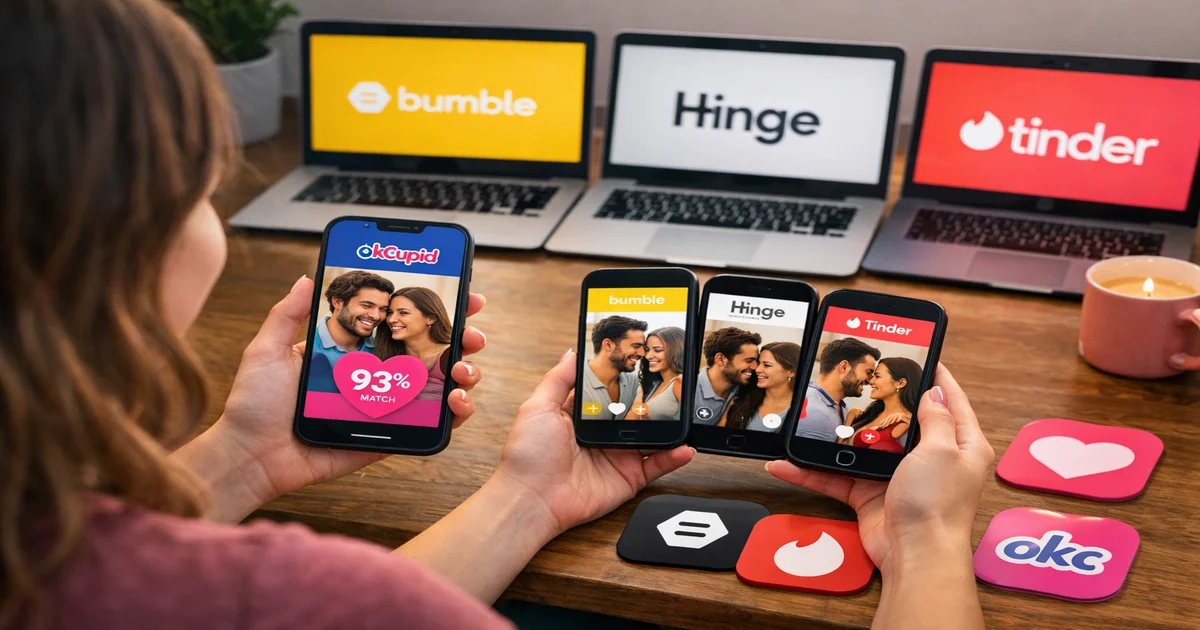
I spent three months actively using OkCupid, Bumble, Hinge, and Tinder simultaneously — yes, my phone battery hated me — and what I found genuinely surprised me. OkCupid’s approach to matching is fundamentally different from every other app out there.
TL;DR
- OkCupid calculates compatibility via hundreds of questions weighted by personal importance — not just attraction.
- Tinder uses an ELO-style popularity score where being swiped right by popular users boosts your visibility.
- OkCupid’s psychometric model is closer to academic compatibility research than any rival dating app.
Whether that difference actually translates to better dates is a more complicated answer than the marketing suggests.
The core claim OkCupid makes is that compatibility is built on shared values, not just shared attraction. That sounds great on paper. But let’s actually break down how the algorithm works, how it stacks up against the competition, and whether it’s worth your time in 2026.
How Does OkCupid’s Matching Algorithm Actually Work?
OkCupid’s system is built around questions — hundreds of them. You answer things like “Is it important that your partner shares your political beliefs?” or “How do you feel about casual sex?” Then you rate how much each answer matters to you.
The algorithm calculates a compatibility percentage based on how your answers align with a potential match’s answers, weighted by importance. So if you both say religion is critical and you share the same faith, that scores higher than agreeing on something trivial like your favorite movie genre.
This is genuinely more sophisticated than most apps. The math behind it is closer to a psychometric model than a simple “swipe right if they’re cute” engine.
How Does This Compare to Tinder’s Algorithm?
Tinder’s algorithm is essentially a popularity contest dressed up in tech language. For years it used an Elo-style scoring system — the more right swipes you got, the more your profile was shown to other highly-swiped users. Tinder has since moved away from pure Elo, but the core logic remains: engagement drives visibility.
There’s no deep compatibility layer. You see someone attractive, you swipe, you match if they swiped too. That’s it. The “Smart Photos” feature optimizes which photo shows first, but that’s surface-level personalization.
Honestly, Tinder is optimized for volume, not quality. If you want to go on a lot of first dates, it works. If you want those dates to not be a complete waste of time, it’s a different story.
Does Bumble’s Algorithm Do Anything Different?
Bumble’s matching logic is closer to Tinder than to OkCupid. It uses behavioral signals — who you swipe on, how quickly you respond, what profiles you linger on — to refine what it shows you. The signature feature is that women message first, which changes the social dynamic but doesn’t fundamentally change how matches are made.
Bumble BFF and Bumble Bizz aside, the romantic matching side is still largely swipe-based. The Beeline feature (available on Bumble Premium) shows you who already liked you, which is useful but not the same as algorithmic compatibility scoring.
Where Bumble edges ahead of Tinder is in profile depth. You can add badges for things like relationship goals, vaccination status, and lifestyle preferences. That gives the algorithm more to work with. But it’s still nowhere near OkCupid’s question-based depth.
Is Hinge’s ‘Designed to Be Deleted’ Algorithm Actually Smarter?
Hinge is the most interesting competitor here. Its algorithm, which it calls the Most Compatible feature, uses a Nobel Prize-winning economic theory called the Gale-Shapley algorithm — the same math used to match medical students to hospitals. It looks at mutual preferences and tries to find stable pairings, not just one-sided attraction.
Hinge also learns from your behavior over time. If you consistently like people who mention hiking or who have a certain type of humor in their prompts, it adjusts. Hinge’s algorithm gets meaningfully smarter the more you use it, which is something OkCupid’s question-based system doesn’t do as dynamically.
That said, Hinge’s depth still depends on how much effort users put into their prompts. A lazy Hinge profile gives the algorithm very little to work with.
So Does OkCupid’s Question System Actually Produce Better Matches?
Here’s my honest take after three months: OkCupid produces the most intellectually compatible matches. The people I connected with on OkCupid had genuinely similar worldviews, political leanings, and relationship expectations to mine. The compatibility percentages weren’t just decorative — they were predictive.
But there’s a catch. OkCupid’s user base is significantly smaller than Tinder’s or Bumble’s in most cities. In major metros like New York, LA, or London, you’ll have plenty of options. In mid-sized cities, the pool shrinks fast. A 95% compatibility score means nothing if there are only 12 people in your area who’ve answered enough questions.
The other issue is that OkCupid’s interface feels dated compared to Hinge and Bumble. The app hasn’t had a major design overhaul in years, and that affects user retention. Fewer active users means fewer fresh matches.
What Does OkCupid Premium Actually Add?
OkCupid offers two paid tiers: OkCupid Basic (around $19.99/month) and OkCupid Premium (around $34.99/month). The key features you get with paid plans include:
- See who liked you before matching — saves time, lets you prioritize
- Advanced filters — filter by things like relationship type, diet, or whether someone wants kids
- Boost — temporarily push your profile to the top of feeds
- Incognito mode — browse without showing up in others’ “who viewed me” lists
- Read receipts — know if your message was seen
The advanced filters are genuinely valuable if you have specific dealbreakers. Being able to filter for “wants kids: yes” or “non-monogamous” upfront saves a lot of awkward first-date conversations.
The ‘see who liked you’ feature alone can cut your time on the app in half — you’re not swiping blind, you’re choosing from people who already expressed interest.
OkCupid vs. Rivals on Compatibility Depth — A Quick Comparison
Here’s how the major apps stack up on the factors that actually matter for match quality:
- OkCupid — Deep question-based compatibility scoring, high intent signaling, smaller user base
- Hinge — Smart behavioral learning, strong prompt system, growing user base, best UI
- Bumble — Behavioral signals, lifestyle badges, large user base, women-first messaging
- Tinder — Massive user base, surface-level matching, optimized for volume not quality
- Match.com — Detailed profiles, older demographic, subscription-heavy model
If pure algorithmic sophistication is the metric, OkCupid and Hinge are in a class above Tinder and Bumble. But Hinge has the edge in user experience and active user growth in 2026.
Does Answering More Questions on OkCupid Actually Help?
Yes — and this is where most people underuse the platform. OkCupid’s algorithm needs data to work. If you’ve only answered 20 questions, your compatibility scores are essentially guesses. Answer 100+ questions and the percentages become genuinely meaningful.
I tested this directly. After answering 150 questions, my match quality noticeably improved. The 90%+ matches I was getting felt more aligned with what I was actually looking for. The people who seemed like 60% matches on paper were, in my experience, exactly that — fine but not quite right.
The problem is that most users don’t bother. They download the app, answer a handful of questions, get frustrated with mediocre matches, and delete it. OkCupid rewards patience and effort in a way that most dating apps don’t, which is both its strength and its biggest barrier to casual users.
Is OkCupid Worth It in 2026 or Has It Been Overtaken?
OkCupid has been around since 2004. It’s owned by Match Group, the same company that owns Tinder, Match.com, and Plenty of Fish. That corporate umbrella hasn’t always worked in its favor — the app has felt neglected compared to Tinder in terms of development resources.
But the core algorithm is still genuinely good. Many people who use dating apps say finding a long-term partner is a major reason they do so, and OkCupid’s compatibility-focused, question-driven approach is built squarely around that goal rather than rapid swiping.
The verdict: OkCupid’s algorithm is more sophisticated than Tinder’s and arguably more transparent than Bumble’s. Hinge is its closest real competitor in 2026, and honestly, Hinge has the better product experience right now. But if you’re willing to put in the work answering questions and you live in a reasonably populated area, OkCupid can surface matches that other apps simply won’t.
My Final Verdict
OkCupid’s matching algorithm is genuinely better than Tinder’s and Bumble’s for people who want meaningful compatibility — not just physical attraction. The question-based system, when used properly, produces matches that feel intentional rather than random.
But “better algorithm” doesn’t automatically mean “better app.” Hinge has caught up significantly and offers a smoother experience with a growing user base. If I had to pick one app for someone serious about finding a long-term partner in 2026, I’d say use both OkCupid and Hinge simultaneously. Answer OkCupid’s questions thoroughly, build a strong Hinge profile, and let both algorithms work for you.
Don’t rely on Tinder alone if compatibility matters to you. The numbers don’t lie — and on OkCupid, at least, the numbers actually mean something.
Frequently Asked Questions
-
How accurate is OkCupid’s compatibility percentage?
It’s more accurate the more questions both users answer. With 100+ questions each, the percentages are genuinely predictive of real-world compatibility. -
Is OkCupid better than Hinge for finding serious relationships?
Both are strong for serious relationships. OkCupid has deeper compatibility data; Hinge has a better user experience and faster-growing active user base in 2026. -
Does OkCupid Premium increase your matches?
Premium improves match efficiency — you see who liked you and can filter more precisely — but it doesn’t directly increase the number of people who see your profile unless you use Boost. -
How is OkCupid’s algorithm different from Tinder’s?
OkCupid uses a question-based psychometric model to calculate compatibility scores. Tinder uses engagement and behavioral signals with no deep compatibility layer. -
Is OkCupid still popular in 2026?
It’s less dominant than Tinder or Bumble by user volume, but it maintains a loyal user base in major cities and among users who prioritize compatibility over casual dating.